
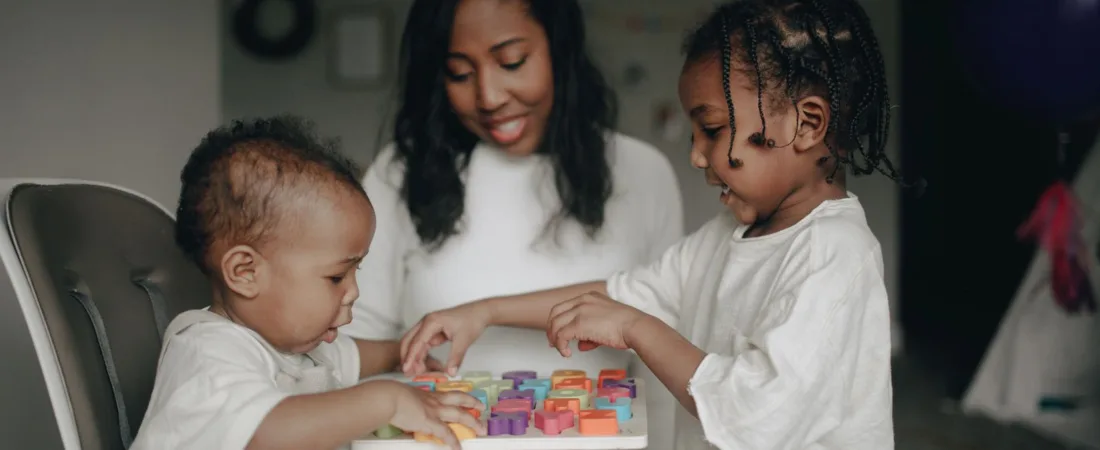
Children learn all day—not only during a clinic appointment. Evidence-informed caregiver programmes use ordinary play, dressing, meals and household routines as opportunities for communication. The aim is not to turn home into a therapy centre. It is to make connection easier and more enjoyable.
Try this today
Choose one enjoyable activity, join for ten minutes, speak less, pause more, and respond to every clear attempt to communicate—whether it is a word, sound, gesture, picture or device.
1. Follow the child’s lead
Start with what already holds the child’s attention: water, cars, songs, blocks, drawing or kitchen containers. Sit nearby and notice what the child does before introducing a new idea.
2. Join before you direct
Copy an action, sound or rhythm. If the child rolls a car, roll another car. Shared enjoyment often creates more opportunities for communication than repeated instructions.
3. Pause and leave space
During a familiar song or routine, pause expectantly for several seconds. The child may look, move, vocalise, reach, sign, point or use a picture. Treat that as meaningful communication and respond.
4. Model one small step
Use language just above the child’s current level. If the child reaches for bubbles, model “bubble”, “more bubble” or the matching sign or picture. Avoid requiring eye contact or perfect repetition before giving access.
5. Offer visible choices
Hold up two snacks, toys or clothes and label them simply. Choices reduce guessing and give the child a useful reason to communicate. Accept a reach or gaze while continuing to model clearer options.
6. Build communication into routines
- At dressing: choose red or blue.
- At meals: request more, finished or help.
- During bath time: ready–set–pause–go.
- While tidying: match, take turns or follow a picture sequence.
Repeat the same small words, gestures or symbols across the day. Predictability helps learning.
7. Respect all communication
Speech is one form of communication. Gestures, signs, pictures and augmentative and alternative communication (AAC) can reduce frustration and expand participation. AAC does not need to be held back until speech “fails”; ask a qualified communication professional for an individual plan.
Keep practice humane
Stop when the child shows clear stress. Regulation and trust come before finishing an exercise. Use the language in which caregivers can be warm, playful and natural. Share what works with therapists and teachers so everyone supports the same functional goals.
Evidence note (reviewed 27 August 2026): WHO Caregiver Skills Training focuses on engagement, communication, positive behaviour, daily living and caregiver coping through play and routines. A 2024 Goa service evaluation found caregivers learned strategies in a transported caregiver-mediated programme, although its retrospective pre–post design cannot prove causation. A 2026 Indian CARER paper reports formative programme development; outcome data are still pending.
Sources and further reading
- WHO Caregiver Skills Training package
- NICE: Play-based social-communication strategies
- Social ABCs implementation in Goa (2024)
- CARER programme formative study in India (2026)
This article is for general education. It cannot diagnose autism or replace individual medical, developmental, educational or legal advice.
Featured image: illustrative stock photography via Pexels. The people shown are not identified as autistic.